Table of Contents
Artificial turf is one of the best investments you can make for your outdoor living space. It eliminates mowing, watering, and fertilizing while providing a lush, green surface year-round. But like any investment, it requires care to deliver its full return. A well-maintained artificial turf installation can last 15 to 25 years. A neglected one may need replacement in as few as 5 to 8 years, costing you thousands in premature replacement.
This guide is the most comprehensive artificial turf maintenance resource available. It covers everything from the 30-second daily tasks that prevent problems to the seasonal routines that keep your turf performing at its best. Whether you installed turf last week or five years ago, this guide will help you get the most from your investment.
Why Maintenance Matters
Artificial turf maintenance is not about vanity. It is about protecting a significant financial investment and ensuring a safe, healthy environment for your family and pets. Here are the four core reasons why regular maintenance is non-negotiable.
Lifespan Extension
Regular maintenance can double the effective lifespan of your turf. Instead of replacing your 1,500 sq ft installation after 8 years ($12,000+), proper care extends it to 20+ years. That translates to tens of thousands of dollars in avoided replacement costs over the life of the product.
Appearance
Without maintenance, turf fibers mat down, infill migrates, and the surface develops an uneven, worn appearance. Regular brushing and grooming keep fibers upright and infill distributed, maintaining the lush, natural look that attracted you to artificial turf in the first place.
Health and Hygiene
Artificial turf can harbor bacteria, mold, allergens, and pet waste residue that pose health risks, especially for children and pets who spend time on the surface. Routine cleaning and periodic sanitizing eliminate these hazards and maintain a safe environment.
Investment Protection
Well-maintained turf enhances curb appeal and property value. Neglected turf does the opposite. If you plan to sell your home, buyers notice the condition of outdoor surfaces. A clean, well-groomed turf is a selling point; a neglected, odorous one is a red flag.
Daily and Weekly Maintenance Tips
These quick, simple tasks take minutes per day and form the foundation of effective turf care. They prevent small issues from becoming big, expensive problems.
Daily Tasks (2 to 5 minutes)
- Remove pet waste immediately. Do not let it sit. Solid waste left on turf stains the fibers and accelerates bacterial growth. Pick it up as soon as possible and rinse the area with a hose.
- Pick up large debris. Branches, food scraps, toys, and other objects left on turf can flatten fibers, attract pests, and create staining opportunities. A quick walk-through takes seconds.
- Address spills immediately. Rinse liquid spills with water as soon as they happen. The longer a spill sits, the harder it is to remove and the more likely it is to stain permanently.
Weekly Tasks (15 to 30 minutes)
- Blow or sweep off leaves and light debris. Use a leaf blower on a low setting or a stiff broom to clear accumulated debris. This is especially important in fall or if your turf is near trees.
- Rinse pet areas thoroughly. Even after daily waste pickup, residual bacteria accumulate in pet zones. A thorough weekly rinse dilutes urine, flushes bacteria through the drainage system, and keeps odors in check between professional cleanings.
- Quick visual inspection. Walk the turf and look for anything unusual: new stains, lifted seams, weed growth, or areas where fibers look matted. Catching problems early prevents them from becoming expensive repairs.
Need Help Maintaining Your Turf?
Connect with local professionals who can set up a maintenance plan tailored to your turf.
Get a Free QuoteMonthly Maintenance Checklist
Once a month, set aside 60 to 90 minutes for a thorough maintenance session. This is the most impactful DIY task you can perform, and it significantly reduces the scope and cost of professional cleanings.
- 1
Complete debris removal
Clear every leaf, twig, and foreign object from the surface. Use a leaf blower for large areas.
- 2
Full surface rinse
Rinse the entire turf area with a hose, paying extra attention to pet zones, high-traffic paths, and areas near outdoor cooking.
- 3
Cross-brush fibers
Using a stiff-bristled broom or turf rake, brush fibers against the grain across the entire area. This lifts matted sections, redistributes infill, and restores appearance.
- 4
Spot-treat stains
Address any stains with a mild soap and water solution. Blot gently, do not scrub. Mark any stains that resist treatment for professional attention.
- 5
Inspect perimeter and seams
Walk the edges and check every seam for lifting, separation, gaps, or weed growth. Press down any lifted edges and note issues for repair.
- 6
Test drainage
Pour a bucket of water on a flat section and time how long it takes to drain. Water should pass through within a few minutes. Slow drainage signals compacted infill or blocked drain holes.
- 7
Check infill levels
Part the fibers in several locations and observe the infill level. It should be about three-quarters of the way up the fiber. Low areas may need professional infill replenishment.
Seasonal Maintenance Guide
Each season presents unique challenges and opportunities for turf maintenance. Follow these season-specific guidelines to keep your turf in top condition year-round.
Spring: Deep Clean and Reset
Spring is the most important season for turf maintenance. Winter weather compacts infill, debris accumulates under snow cover, and dormant bacteria wake up as temperatures rise. This is the ideal time for your annual or semi-annual professional cleaning.
- Schedule professional deep cleaning and sanitizing
- Remove all winter debris and accumulated organic matter
- Check and replenish infill levels
- Inspect edges and seams for winter damage
- Apply pre-emergent weed treatment if weeds are a recurring problem
Summer: Cool, Rinse, and Protect
Summer heat is the biggest challenge for artificial turf. Surface temperatures can reach 120 to 170 degrees Fahrenheit on hot days, making the turf uncomfortable and accelerating UV wear on fibers. Regular rinsing cools the surface and prevents heat-related degradation.
- Rinse turf with water before use on hot days to lower surface temperature by 30 to 50 degrees
- Increase rinsing frequency for pet areas to twice weekly
- Check for and remove any objects that could melt onto the surface (glass, metal)
- Move heavy furniture periodically to prevent permanent fiber compression
Fall: Clear and Prepare
Fall brings the biggest debris challenge, especially if your turf is near deciduous trees. Leaves left on turf decompose, stain fibers, block drainage, and create a breeding ground for mold and pests. Frequent clearing is essential during this season.
- Blow or rake leaves off the turf at least twice per week during peak leaf fall
- Schedule a professional cleaning before winter to remove accumulated organic matter
- Check drainage to ensure leaves have not clogged drain holes or perimeter channels
- Do a thorough cross-brushing to prepare fibers for winter weight from rain or snow
Winter: Protect and Monitor
Winter is the lowest-maintenance season for most turf owners, but there are still important precautions, especially in regions with freezing temperatures. The main concerns are ice, snow weight, and restricted drainage from frozen ground.
- Let snow melt naturally when possible rather than shoveling, which can damage fibers
- If you must remove snow, use a plastic shovel or snow blower on a high setting to avoid contact
- Never use chemical de-icers or salt on artificial turf, as they can degrade fibers and infill
- Limit foot traffic on frozen turf, as fibers become brittle and more susceptible to breakage
Common Problems and Solutions
Even with excellent maintenance, issues arise. Here are the most common artificial turf problems, what causes them, and how to resolve them effectively.
Matting and Flattening
Cause: Heavy foot traffic, furniture, compacted infill.
Solution: Regular cross-brushing in multiple directions with a stiff-bristled broom. For severe matting, professional power brushing with industrial equipment restores fibers to their upright position. Prevent recurrence by rearranging furniture periodically and ensuring infill levels are adequate.
Persistent Odor
Cause: Pet urine crystallization in infill, bacterial growth, poor drainage, organic decay.
Solution: DIY rinsing provides temporary relief but does not address the root cause. Professional enzyme treatment breaks down uric acid crystals at the molecular level, permanently eliminating the odor source. Improving drainage and increasing rinse frequency prevents recurrence.
Weed Growth
Cause: Seeds settling in seams and edges, gaps in weed barrier, organic material accumulation.
Solution: Pull visible weeds by hand before they establish root systems. Apply a turf-safe, non-toxic pre-emergent herbicide to prevent new growth. For recurring weed problems, a professional can inspect the weed barrier and seal any gaps in seams or edges.
Drainage Issues
Cause: Compacted infill, clogged drainage holes, settled base material, organic debris buildup.
Solution: Clear any debris blocking drainage paths. For widespread drainage problems, professional service includes infill decompaction and drainage hole clearing with specialized equipment. Severe cases may require base inspection and correction, which is a professional-only task.
Discoloration
Cause: UV exposure, chemical spills, staining from organic materials, reflective heat from windows.
Solution: Mild discoloration from UV is normal over many years. Chemical and organic stains should be treated professionally with appropriate products for the specific stain type. Reflective window heat is a common cause of localized melting or discoloration; window films or screens can redirect the concentrated heat.
Tools and Products You Need
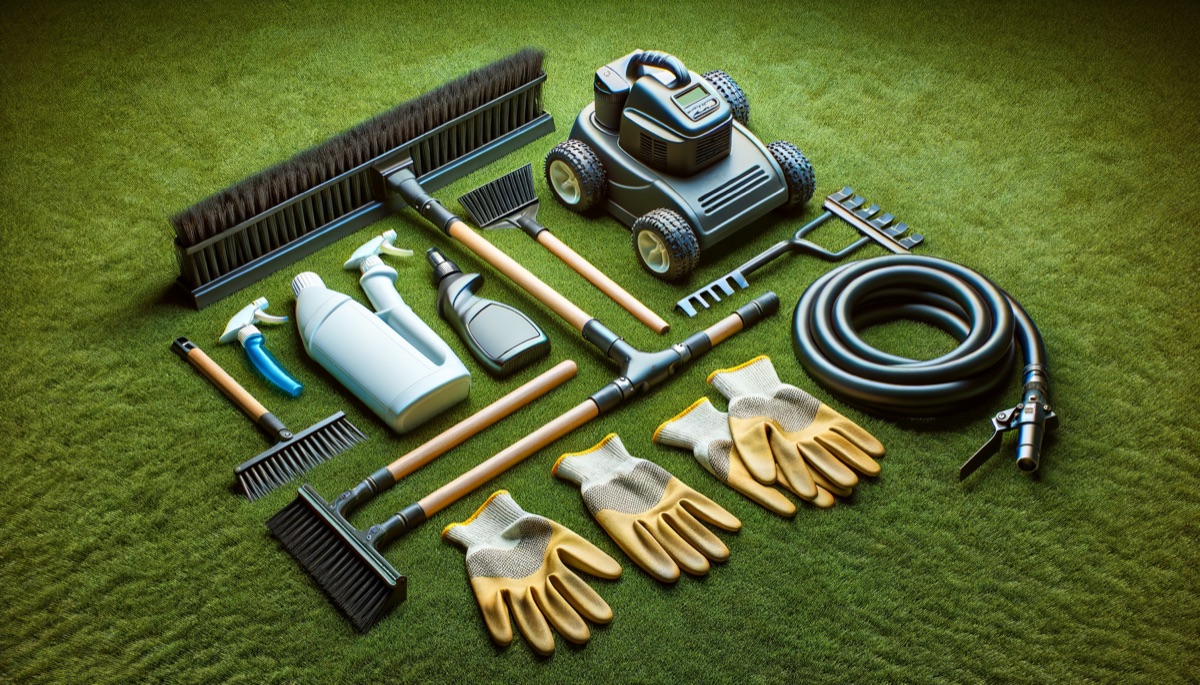
You do not need expensive equipment for routine maintenance. Here are the essential tools and products every artificial turf owner should have on hand.
Essential Tools
- Stiff-bristled push broom or turf rake ($20 to $40)
- Garden hose with adjustable spray nozzle ($15 to $30)
- Leaf blower (electric or battery, $50 to $150)
- Clean rags or microfiber cloths for spot cleaning
- Waste bags and gloves for pet cleanup
Recommended Products
- Turf-safe deodorizer (enzyme-based preferred)
- Mild dish soap (for spot cleaning only)
- White vinegar (for light mineral deposits)
- Turf-safe pre-emergent weed preventer (if weeds are an issue)
- Avoid: bleach, ammonia, acetone, harsh chemicals
When to Call a Professional
DIY maintenance is essential, but there are specific situations where professional service is the only effective option. Here is when to pick up the phone.
Maintenance Cost Breakdown
Understanding the ongoing costs of turf maintenance helps you budget effectively and appreciate the value of your investment. Here is what to expect annually.
| Expense | Frequency | Annual Cost |
|---|---|---|
| DIY supplies and tools | As needed | $50 - $150 |
| Professional cleaning (1 to 2 visits) | Semi-annual or annual | $299 - $565 |
| Infill replenishment | Every 1 to 3 years | $128 - $240 (annualized) |
| Seam and edge repairs | As needed | $0 - $200 |
| Total Annual Maintenance | $327 - $970 |
For perspective, natural grass costs $1,000 to $3,000+ per year in water, fertilizer, mowing, and lawn care services. Even at the high end of turf maintenance, you are still saving money compared to natural grass, while enjoying a consistently green, usable surface year-round. For detailed pricing by service type, visit our turf cleaning cost guide.